
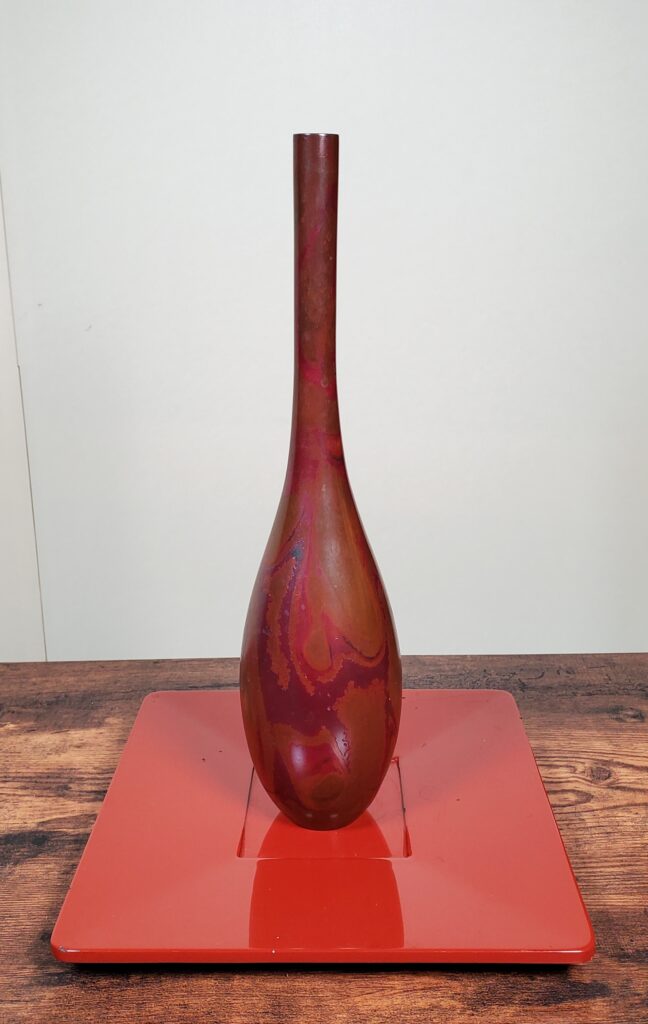
This Showa-period (1926-89) flower pot from Japan is made of bronze and is in new condition. It provides a useful starting point for learning how to distinguish traces left by a mould from details shaped or softened during hand finishing.
Bronze casting begins with a prepared form and a mould, although the exact sequence varies with the casting method. Molten bronze enters the cavity inside the mould and takes on its shape as it cools. When the casting is removed, the intended form is present, but its surface may still carry seams, projections, pits, and uneven passages created during pouring and cooling.
Those first marks are only the beginning. Excess metal must be removed, joins may need to be levelled, and selected areas can be filed, abraded, or polished. The completed surface therefore contains evidence from more than one stage: the mould establishes the form, while later tools alter what remains visible. Reading a bronze means looking for the boundary between those stages rather than treating the surface as a single, uniform finish.
This distinction also prevents a common mistake. A line or shallow depression may suggest part of the casting process, but one mark alone seldom explains how an object was made. Its position, direction, repetition, and relationship to nearby tool marks all matter. Casting evidence is strongest when several clues point to the same sequence of work.
Begin with faint vertical or horizontal lines along the body of a bronze. Where parts of a mould met, a narrow ridge could remain after the metal cooled. Finishing might remove most of that ridge without erasing it completely, leaving a line that is easier to detect in angled light than from the front. On curved forms, follow the line with your eye and ask whether it continues around or down the body in a way that reflects the mould’s geometry.
Not every line is a mould line. Scratches tend to be less regular, while decorative lines usually belong to a deliberate pattern. A possible mould residue often follows a structural path and may become more visible near a change in contour. If a line stops abruptly, shifts direction, or appears only as an isolated mark, it needs to be considered alongside the surrounding surface before drawing a conclusion.
Small pits and patches of uneven texture are another source of evidence. They can occur when the bronze does not settle against the mould with complete uniformity or when gas affects the surface during pouring and cooling. Their value lies less in any single pit than in their distribution. A scattered, irregular area reads differently from a passage covered by repeated, parallel strokes. The first may retain more of the cast surface; the second may show where a tool was used afterward.
Edges deserve particular attention. Rims, openings, feet, and changes in contour often require extra cleaning because excess metal or a pronounced seam can collect there. A crisp edge beside a softer, slightly uneven field may indicate that the edge received more finishing. The contrast between adjacent passages can be more informative than either passage viewed alone.
Cast detail and hand-finished detail can appear in the same area, so the question is not simply whether a passage is smooth or rough. Instead, look at the character of the marks. Cast texture is often irregular, with no consistent direction. Tool work more often has a repeated path: parallel file marks, fine abrasive lines, or an even polish produced by passing over the same area several times.
Transitions are especially revealing. Examine where a broad surface meets a narrow one, where a curve changes direction, or where an edge interrupts the body. These are places where a finisher may have needed to remove a seam without flattening the surrounding form. If the central field retains slight irregularities while the transition is smoother, the difference may show how selectively the surface was worked.
Raking light is the simplest aid. Place the light low and to one side so that it travels across the bronze rather than striking it directly. Shallow ridges cast narrow shadows, pits become more legible, and fine directional marks can emerge from an apparently even surface. Rotate the object only when handling is permitted; otherwise, change your viewing position or the direction of the light. A mark that appears under several angles is easier to assess than one produced by a single reflection.
Touch can sometimes add information, but only where handling is allowed. A fingertip moved lightly across a surface may detect a ridge or a shift in texture that the eye misses. The purpose is not to hunt for defects. It is to reconstruct a sequence: where the mould left a trace, where excess metal was removed, and where files, abrasives, or polishing tools softened the cast surface.
When you next examine a Japanese bronze, which would you notice first: a faint line following the body, an irregular patch preserved between smoother areas, or the directional marks of later finishing?
Contact us at giulio.dirienzo@gallerymitsuido.com or visit us at 3 Chome-1 Kamiokamotomachi, Takayama, Gifu 506-0055, Japan.