
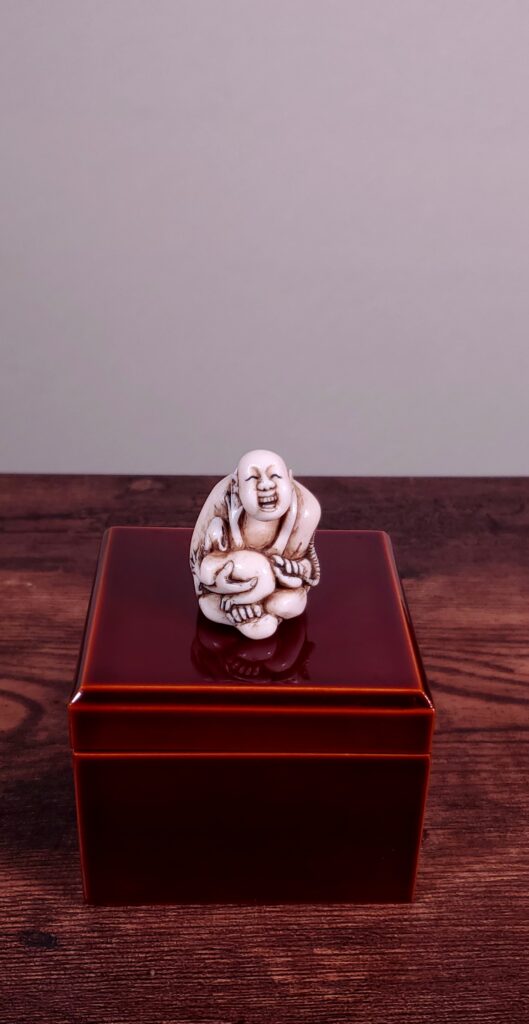
This signed Showa (1926-89) netsuke miniature was carved in ivory in Japan and is in new condition. Its himotoshi, the small cord channels worked into a netsuke, offer a focused lesson in how practical demands can shape a carving.
Himotoshi generally consist of two openings connected by an internal passage. Rather than continuing as separate straight holes, the openings are commonly drilled at angles that meet within the carved form. Their position therefore depends on more than surface appearance: the carver must consider the route of the internal channel as well as the amount of solid substance surrounding it.
Placement begins with the overall form. On a compact netsuke, the underside of the base may provide enough depth for a connected passage while keeping the openings away from prominent carving. Other forms may offer a recess beneath drapery, the back of a rounded mass, or another quiet area where the channel can be incorporated without interrupting a face, hand, or finely worked detail. The solution changes with the shape, but the governing question remains the same: where can the openings sit without weakening the carving or disturbing the main composition?
This makes himotoshi part of the initial design rather than a detail added without forethought. Their route must be anticipated while the surrounding mass is still being established. If too much is removed nearby, the channel may lack sufficient support. If the openings are assigned an awkward position, they can interrupt the surface or force the internal passage through an unsuitable area. A convincing placement resolves these constraints without drawing unnecessary attention to the solution.
Begin by looking at the relationship between the two openings. Because the internal passage commonly turns through the carved form, they need not appear as symmetrical mirror images. One may sit slightly higher or meet the surface at a different angle. Such differences are not automatically signs of careless work; they may follow the route required by the available mass.
Next examine the edges and the surrounding surface. A sharply cut rim can make an opening appear detached from the rest of the carving. A carefully smoothed transition allows it to belong to the same curves and planes as the base. The question is not whether the openings disappear completely, but whether their placement and finish make sense within the form.
The internal channel also matters. Its route should connect the openings cleanly rather than feel like two unrelated drillings. On rounded forms, the curve of the base can provide a natural path. On forms with folds, projections, or changes in depth, the available route may be less direct. The carver must retain enough substance around the passage while keeping it clear of more delicate surface work.
Comparison makes this design judgement easier to see. Set a smoothly incorporated pair of himotoshi beside openings drilled through a flat area with little adjustment to the surrounding surface. In the first case, the base and channel appear to have been considered together. In the second, the openings can seem separate from the carving. The distinction lies not in decoration but in how thoroughly one small practical requirement has been absorbed into the whole.
Himotoshi are useful because they direct attention to decisions that are easy to miss from the principal viewing angle. Check where the openings sit in relation to the deepest and thinnest parts of the form. Follow their angles and consider where the passage must meet inside. Then look at the rims: are they abrupt, or does the surrounding surface lead into them cleanly?
Also consider whether the position supports the larger composition. Openings placed in a quieter area allow the eye to move across the main carving without interruption. When the channel follows an existing curve or recess, the practical requirement and the carved shape reinforce each other. This is design judgement at a small scale: not the addition of another motif, but the resolution of drilling, structure, and finish within limited space.
Neither placement nor finish alone establishes the age or source of a netsuke. Himotoshi are best read as evidence of how the carving was planned and resolved. They show whether the underside received the same attention as the more immediately visible passages.
When you next examine a netsuke, start with the underside. Where do the two openings sit, how do their angles relate, and how smoothly have they been worked into the surrounding form? Once you begin checking himotoshi first rather than last, what other design decisions become easier to see?
For details or private viewing, contact Gallery Mitsuido at giulio.dirienzo@gallerymitsuido.com or visit us at 3 Chome-1 Kamiokamotomachi, Takayama, Gifu 506-0055, Japan.