
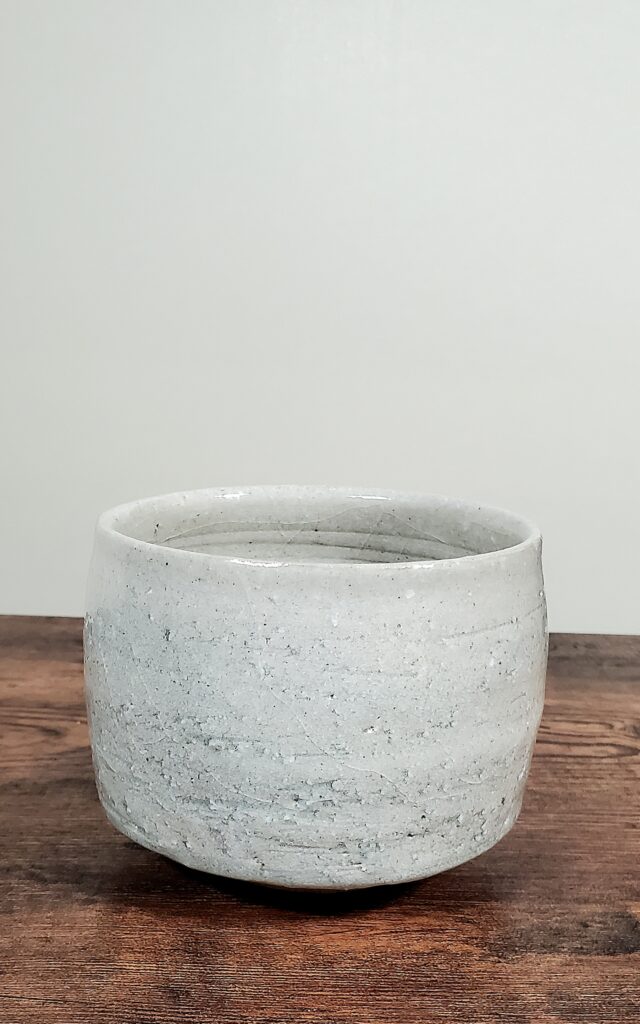
Hototogisu is a signed contemporary ceramic cup from Japan by Keisuke Katou, presented in new condition. Seen alone, it encourages attention to its form and glaze. That isolated view offers an entry into a broader question: how should we look at Japanese tea bowls, which belong to a setting larger than any one vessel?
In Japanese tea practice, the bowl appears within a group of implements brought together for a sequence of preparation and drinking. The whisk moves inside the bowl to prepare the tea. The scoop carries the powder. A water jar keeps fresh water within reach, while a brazier or other heat source maintains the hot water needed nearby. These objects are distinct, but they are encountered through their practical relationships with one another.
The bowl therefore has to accommodate more than the drink it holds. Its opening must leave room for the whisk to move, while its depth affects how that movement takes place. The rim meets the drinker, and the foot gives the hand a point from which to lift and turn the bowl. Scale, balance, and surface all take on meaning through contact with hands, utensils, and the surrounding arrangement.
A gallery presentation temporarily removes those relationships. With the other implements absent, the bowl becomes an isolated silhouette and surface. This is not a failure of display; it is simply a different mode of looking from the one established by tea practice. Recognising the distinction helps explain why the design of a tea bowl cannot be understood only as a self-contained composition.
Once a tea bowl is imagined within the larger setting, qualities that may look plain in isolation begin to make more sense. The bowl shares a limited field of attention with the whisk, scoop, water jar, heat source, and the movements that connect them. Understatement allows it to remain visually present without making every other element seem secondary.
This does not mean that every tea bowl must be undecorated or visually subdued. It means that decoration is read in relation to an active setting rather than against the empty space of a display shelf. A strong pattern, pronounced colour, or varied glaze may become one moment within the sequence. A quieter surface may hold its place through proportion, weight, and the way it meets the hand. Neither approach exists independently of the objects and actions around it.
Isolation can exaggerate the importance of surface treatment because there is little else for the eye to compare. Within a tea setting, the same surface participates in a wider arrangement of textures, scales, and shapes. The bowl does not need to carry the entire visual experience. Its restraint can instead help distribute attention across the setting and across time, from preparing the tea to lifting the bowl and returning it.
This is why understatement should not automatically be read as a lack of detail. In tea ware, restraint can be a form of coordination. The bowl has enough visual identity to be considered closely, but it also leaves room for the whisk, scoop, water jar, and brazier to remain legible. What seems quiet on its own may be precisely what allows the larger arrangement to remain coherent.
When a tea bowl is presented alone, mentally supplying the absent implements can make the design easier to read. Picture the whisk beside it, the scoop approaching the opening, the water jar within reach, and the low heat source nearby. Then consider how the bowl would be lifted, turned, approached by the whisk, and returned to its place.
This exercise changes which details matter first. Instead of beginning only with decoration or colour, begin with the opening, walls, rim, weight, and foot. Ask whether the opening gives sufficient room for preparation, how the walls relate to the hand, and where the fingers would find support. These questions connect visible form to the wider sequence in which a tea bowl is encountered.
Comparison also becomes more useful when it is based on relationships rather than display impact. Two bowls may appear equally restrained on a shelf yet suggest different experiences once the whisk, hand, and surrounding implements are brought back into the reading. The distinction may lie in how open or enclosed the bowl feels, how its weight is distributed, or how directly the foot can be grasped.
The next time you encounter a tea bowl on its own, try reconstructing the rest of the setting before judging the vessel in isolation. Which detail changes most once you imagine the whisk, water jar, scoop, and brazier beside it?
For details or private viewing, contact Gallery Mitsuido at giulio.dirienzo@gallerymitsuido.com or visit us at 3 Chome-1 Kamiokamotomachi, Takayama, Gifu 506-0055, Japan.