
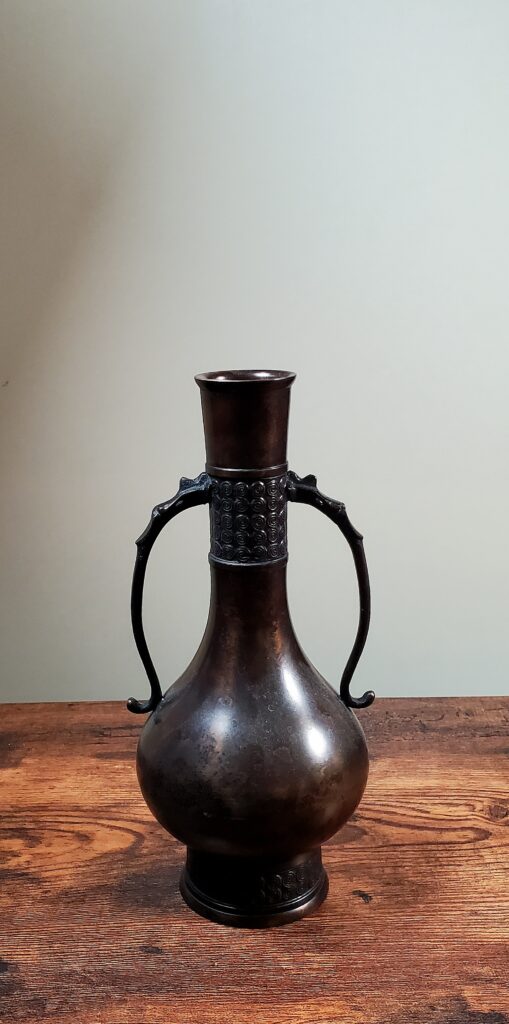
This bronze flower pot was made in Japan during the Showa (1926-89) period. Two curved handles rise from the shoulder to the neck. A handle’s position, angle, and clearance offer a useful starting point for understanding how a bronze vessel’s form relates to handling.
On Japanese bronze vessels with working handles, the attachments connect the grip to the weight it must support. Two attachment points, one near the rim or neck and another lower on the shoulder or body, spread that load across the vessel. The upper attachment often sits at the transition between neck and shoulder, with the lower one farther down on the body. Their spacing helps explain how force passes from the hand into the vessel during lifting or tilting. Balance also depends on where the grip sits in relation to the centre of mass: the weight of the body and its contents together.
Handle height alone cannot tell you whether a vessel will tip. The grip’s distance from the centre of mass matters, as does the support supplied by another hand. A side handle places the hand away from the body’s centre, so keeping the vessel level can require effort at the wrist or support beneath the body. Two handles allow the weight to be shared between hands. These relationships make attachment points useful clues, although their appearance alone cannot establish how an individual vessel was used.
Follow the curve between those attachments. An outward arc leaves space for fingers between the handle and the shoulder; a tighter loop reduces that space. The angle at which the handle leaves the body also affects how the hand approaches it. Imagine wrapping your fingers around the grip: would your knuckles clear the shoulder, and could your wrist stay comfortably aligned? A broad opening may accommodate a full hand, while a small loop may admit only a few fingers. That comparison helps you assess the grip a form allows without assuming that every loop was intended to bear the vessel’s weight.
On bronze vessels designed for pouring, a spout adds another relationship to examine: the outlet’s position in relation to the contents and the hand controlling the tilt. Its height affects how far the vessel must tip before liquid reaches the outlet. An outlet below the main rim can also limit how much liquid the vessel holds upright without spilling. Trace the route from the body to the spout’s tip, then imagine how that route changes as the vessel tilts.
The angle of a spout does not determine the stream by itself. The passage’s width, the outlet’s shape, the amount of liquid, and the degree of tilt also affect the pour. A shallow spout does not necessarily produce a fast, broad stream, nor does an upward-pointing one guarantee a slow, narrow stream. Length has a more immediately visible consequence: it carries the outlet farther from the body. This gives the stream clearance from the vessel and helps place it over a receiving opening.
Handle and spout therefore need to be considered together. The handle provides a place to support and turn the vessel; the spout directs the liquid as that turn happens. Imagine the wrist movement required to bring the outlet into a pouring position. Then consider whether the body leaves room for a second supporting hand. This connects the silhouette to a practical sequence of movements without requiring any assumptions about how a particular bronze was made.
Extend that reading to the body, neck, and base. A wider body changes the distance between a side grip and the weight it supports. The neck’s height affects the space around an upper attachment, while the base provides support when the vessel is set down. These proportions belong to the same handling problem. In a vessel intended for use, a comfortable grip needs enough clearance, adequate support for the load, and a workable position for the hand.
When comparing Japanese bronze vessels, begin with a few concrete relationships: body width and handle span, grip size and finger clearance, spout height and the tilt needed to pour. Keep the vessels on their supports while making these visual comparisons. The useful question is how comfortably the parts appear to work together. Surface ornament can draw attention first, but the space inside a handle and the direction of a spout give you specific features to examine when considering practical design.
Where, on the next bronze vessel you look at closely, does the handle’s curve actually leave room for your own hand?
For details or private viewing, contact Gallery Mitsuido at giulio.dirienzo@gallerymitsuido.com or visit us at 3 Chome-1 Kamiokamotomachi, Takayama, Gifu 506-0055, Japan.