
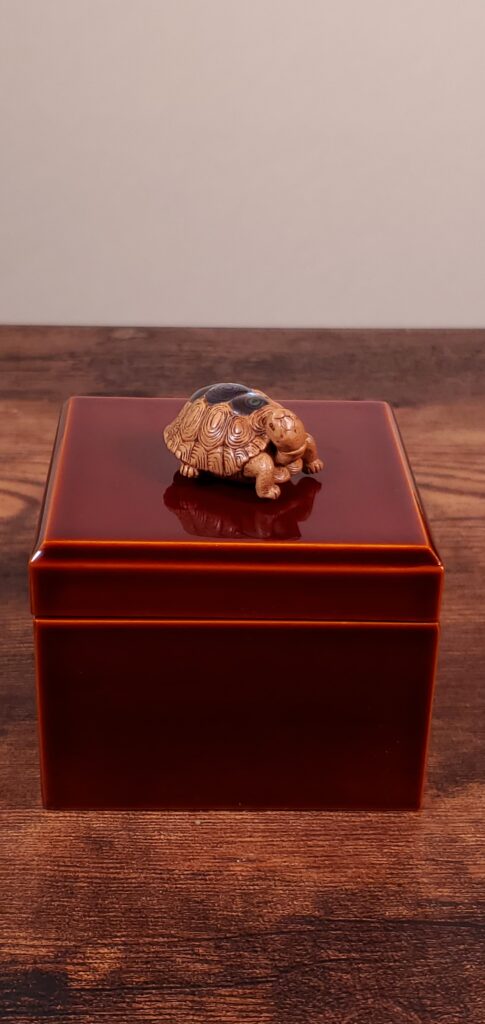
Kame, by Nakahata Noboru, is a signed wood netsuke carved in Japan during the Showa period (1926–89). Netsuke offer a useful lesson in how small sculptures direct attention: a scene draws us toward relationships between figures and objects, while a compact form encourages us to follow its outline and surface as we view it from different sides.
Netsuke encompass a wide range of subjects, and one useful way to compare them is by structure. A figural netsuke may present a small scene: a seated person with an implement, two figures interacting, or a creature posed mid-action with secondary elements attached to the main form. Reading such a composition means scanning across its parts and following the relationships between them, much as you would read a small tableau.
A compact netsuke directs attention differently. A tortoise, a coiled snake, a folded leaf, or a single shell can provide the basis for one unified mass. Carved detail may cover that mass, but the overall outline remains easy to grasp. The first impression comes from the whole shape; closer looking then reveals how its smaller features fit within that shape. A recognizable animal or object can approach abstraction when its simplified outline becomes as prominent as its identity.
These descriptions overlap. An animal is still a figural subject, even when its body forms a compact shape. Here, the useful distinction is between a composition that asks us to connect several elements and one that concentrates attention on a single mass. Naming the subject tells us what is depicted. Examining the structure tells us how to look at it.
In an open figural composition, separated limbs, raised props, and gaps between elements give the eye several places to pause. A hand may lead attention toward an implement; the direction of a face may connect one figure to another. Each part gains meaning through its position beside the others. Even without identifying a particular story, a viewer can follow those connections and distinguish the main action from supporting detail.
A compact composition brings those features close to the body. In a compact tortoise form, for example, legs tucked against the shell contribute to a unified outline. The transition from one feature to the next becomes especially important: where does a leg separate visually from the body, and where does it merge back into the larger shape? Looking at that boundary explains how a recognizable creature can also read as a single rounded mass.
Turning changes the reading of both kinds of composition. A scene may reveal an overlap or a relationship that was hidden from the front. On a compact carving, rotation makes it easier to follow a curve or see how a repeated pattern continues around the surface. Carved shell segments on a domed form, for instance, need to be understood in relation to that curve. A fixed view shows only part of the relationship between surface detail and the shape beneath it.
A tightly compressed scene can read from a distance as one rounded mass, then resolve into several figures at close range. A single animal can have an intricate surface that requires prolonged inspection. The amount of detail alone therefore tells us little about where a netsuke sits on this spectrum. What matters is how that detail is organized: does it help establish relationships between separate elements, or articulate the surface of a unified form?
Compare the outline first, then the interior detail. With a figural scene, follow the direction of heads, limbs, and implements to see how the parts connect. With a compact form, trace the contour and examine transitions between textures. Notice where a gap interrupts the outline and where adjacent features share a continuous edge. These observations give substance to words such as “open” and “compact” without requiring a story for every carved mark.
Try returning to the whole shape after examining one small detail. In a scene, that detail may clarify an interaction. In a compact carving, it may make a curve or boundary easier to see. Both approaches involve close attention, but they organize it differently. Recognizing that difference helps explain why two equally detailed netsuke can require different ways of looking.
When you next compare two netsuke, which draws you first toward a small scene, and which makes you want to follow the shape around to its other side?
For details or private viewing, contact Gallery Mitsuido at giulio.dirienzo@gallerymitsuido.com or visit us at 3 Chome-1 Kamiokamotomachi, Takayama, Gifu 506-0055, Japan.