
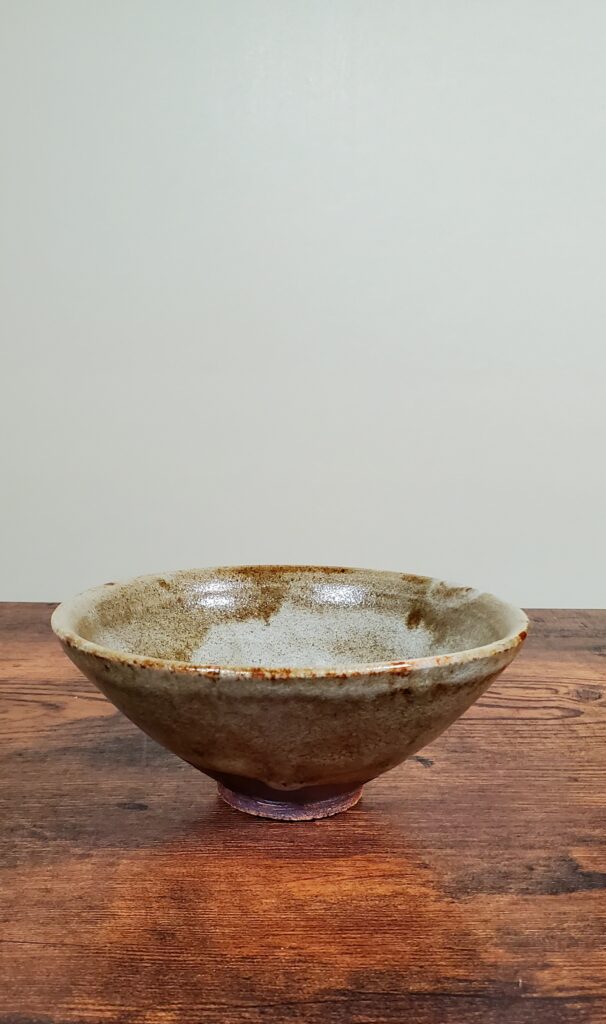
This contemporary ceramic cup from Japan is in new condition at Gallery Mitsuido in Takayama, in the Hida region of Gifu Prefecture. Its wide opening above a small, narrow foot draws attention to the base. On Japanese tea bowls, this small area offers several clues to how a vessel was made.
The foot brings several kinds of evidence together: the clay itself, the way the base was cut and finished, and the point where the glaze ends. Looking beneath a tea bowl adds information that the wall and interior may conceal. It also lets you compare the surface seen from above with the clay exposed below.
Where a foot is left bare, the clay body is visible directly. Look at its colour, which may run from pale buff to deep reddish brown depending on the clay and the heat it met. Look at its grain, which may be fine and smooth or coarse, with small specks and pits. These details provide a starting point for comparing the exposed clay with the surface above it.
Colour and texture need to be read together. A smooth area and a coarse area can catch light differently, making their surfaces easier to distinguish as the bowl is tilted. Bare clay also gives you a reference for looking at places where a thin glaze allows the clay colour to show through. Follow that relationship from the base toward the wall, keeping the exposed clay in mind as you examine the coated surface.
After a bowl has been formed and the clay has stiffened to a leather-hard state, a potter commonly turns it over and cuts the foot with a trimming tool. Concentric rings, a faint spiral, or a small raised centre can remain on the base of tea ware. These traces help you examine how the clay was removed and how the remaining surface was finished.
Start with the edges of the foot ring. A crisp ring with an even height and clear inner and outer edges looks different from one that is rounded, slightly uneven, or marked by tool chatter: the small regular ripples a tool can make as it skips across clay. Neither is automatically better. Compare the sharpness of the edges, the smoothness of the cut surfaces and any marks left between them. Each gives a more specific observation than simply calling the foot neat or rough.
Then look at how the foot is proportioned to the form above it. A small, narrow foot beneath a wide, open shape leaves a bowl resting on a limited area, while a taller or broader foot changes its stance. Seen from the side, the foot ring sets the height at which the body is lifted above the table. Seen from beneath, its inner and outer edges show the width of the ring itself. The two views answer different questions about the same part.
The glaze edge near the foot also gives practical information. Glaze that reaches the surface on which a bowl rests can fuse it to the kiln shelf during firing, so the coating typically stops short of the base or is wiped away beforehand. The resulting boundary lets you examine both the glaze and the exposed clay beside it.
Follow that edge around the bowl. A wiped edge may run in a clean, nearly level line. A dipped coating may end in a slightly wavering line, sometimes with a drip or a thickened bead where it gathered. These are clues to examine together; an edge alone does not establish how a coating was applied. Where a glaze is thick it may form a soft, rounded lip, and where it is thin the clay colour may show through.
When handling is permitted, hold a bowl low over a soft cloth on a table and tilt it toward the light. Follow the foot ring in a slow circle. Watch the height of the ring, the texture of the bare clay, the trimming marks on the base and the glaze line. Then compare the foot with the rim and wall above it, and see whether the clay colour at the base echoes tones elsewhere on the surface.
Compare two tea bowls side by side, one with a foot ring cut crisply and one with a softer, rounder foot. Then compare where the glaze stops on each. Which difference is easiest to see from the side, and which becomes clear only when you look underneath?
Contact us at giulio.dirienzo@gallerymitsuido.com or visit us at 3 Chome-1 Kamiokamotomachi, Takayama, Gifu 506-0055, Japan.