
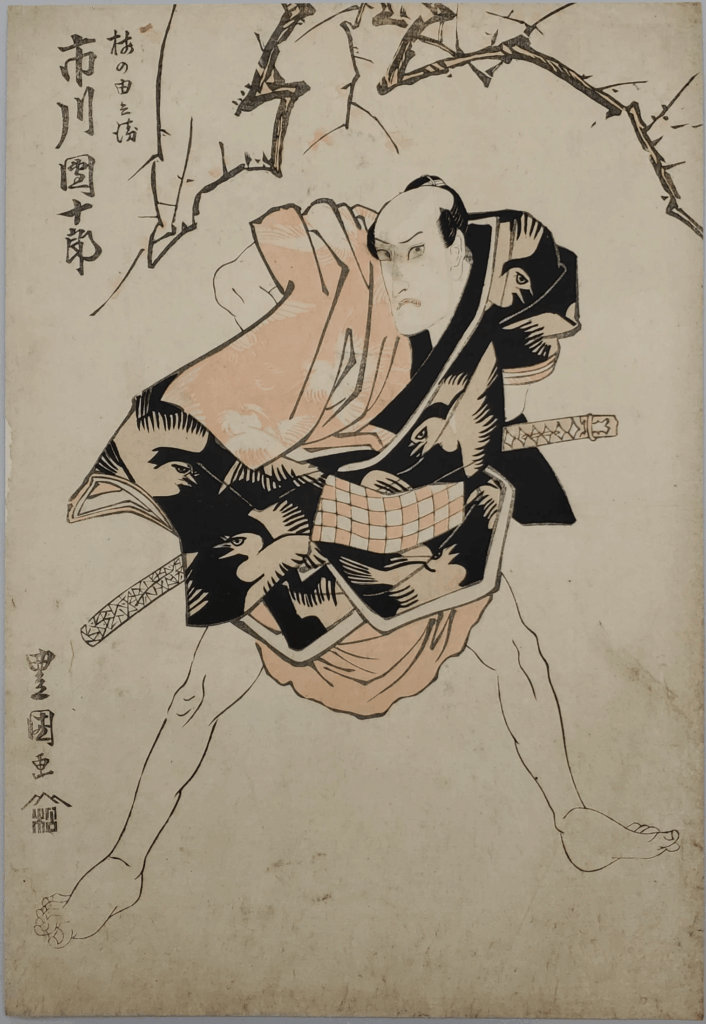
Gallery Mitsuido in Takayama, in the Hida region of Gifu Prefecture, presents Kabukie Ichikawa Dannjyuurou, a woodblock print in washi and ink by Utagawa Toyokuni. Ink loading, pressure, colour alignment, and gradation all shape how a printed design appears on paper.
A ukiyo-e design is transferred to wood and cut into relief, and printing then happens one colour at a time. For each colour, the printer brushes ink or colour onto the raised surface of a block, lays a sheet of damp washi over it, and rubs the back of the paper with a hand-held pad. Three variables in that moment change what lands on the paper: how much colour is loaded onto the block, how evenly it is spread, and how firmly the pad presses.
A heavily loaded block under firm pressure can give a dense, saturated area. Sometimes a slight halo of colour spreads just past the cut edge. A lightly loaded block under gentle pressure can leave a thinner layer, with the paper fibres showing through it. The same block can therefore give a deep, solid area on one sheet and a paler, slightly mottled area on the next. Colour density alone does not tell us how much ink was applied: pressure and contact with the paper also affect its transfer.
Pressure also leaves a physical trace. Where the pad has pressed firmly, the paper can be pushed very slightly into the shape of the block. Tilt a woodblock print under a raking light and you can sometimes see those faint shallow contours, especially around solid areas of colour and dark lines.
Colours printed from separate blocks have to land in the right spot on the same sheet of paper. Printers use registration marks cut into the block, usually a corner notch and a straight edge, so the paper can be laid down in the same position for each pass. The system is precise, but it is operated by hand on paper that is damp and slightly elastic.
A small shift can produce either a gap or an overlap. If a colour lands a little short of its neighbour, a hairline of bare paper appears between the two areas. If it lands a little long, the two overlap and a narrow strip of darker, mixed colour can form along the border. A small overlap can also be built into the design, because it is less visible than a gap. An overlap alone is therefore insufficient evidence of a printing error.
Registration is easiest to judge along an outline. Follow one edge where a colour area meets a drawn line or another colour. Check whether the colour stops cleanly at the line, tucks beneath it, or leaves a thin margin of paper showing. Then follow another edge elsewhere on the sheet. Comparing several boundaries helps reveal whether a colour has shifted consistently relative to the lines around it.
Graded colour depends closely on how the printer prepares the block for each sheet. To make a colour fade, the printer dampens the block, or wipes or brushes it unevenly, so more colour sits at one end of the area and less at the other. Within the carved area, the starting point and extent of the fade depend on how the colour was spread before that particular sheet was pulled.
Two impressions from the same set of blocks can consequently differ in several visible ways. One impression may fade early and another late. A flat area may be even in one and cloudy in another. The choice and dilution of colours can also vary between printing runs. Compare how colour is graded, where it sits flat, and how cleanly the colours align: these are places where differences in printing are easiest to see.
Washi plays its part in all of this. A sheet of paper absorbs colour at a rate that depends on its fibres and its dampness, so the same loading of colour can look different from one sheet of paper to the next. The finished surface is the combined result of block, colour, paper, and the hand that pressed them together.
On the next woodblock print you look at, follow one outline where two colours meet. Does the colour stop at the line, overlap it, or leave a thin strip of bare paper?
Contact us at giulio.dirienzo@gallerymitsuido.com or visit us at 3 Chome-1 Kamiokamotomachi, Takayama, Gifu 506-0055, Japan.