
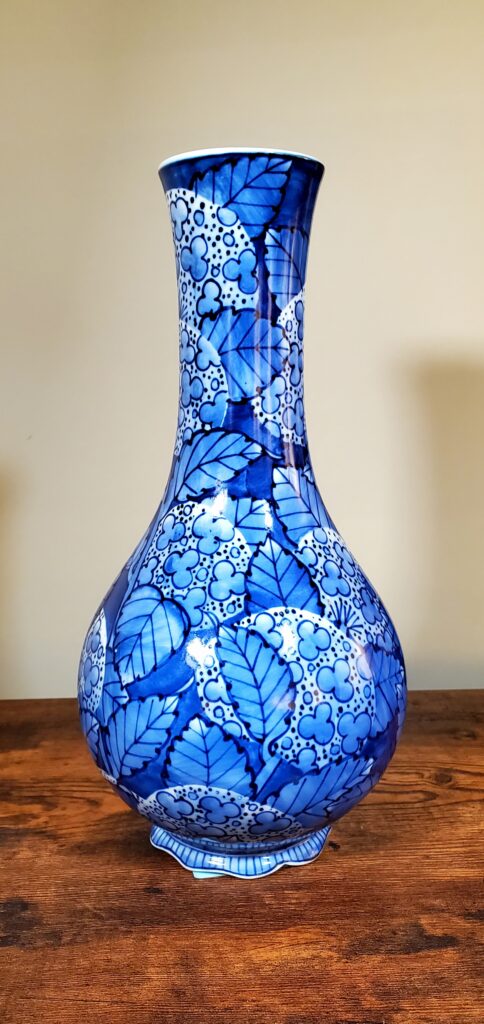
A tall, narrow-necked flower pot raises a practical question: how does its shape serve flowers, and how does it work as an object of display? This signed flower pot by Reihou, made in Japan in Arita porcelain during the Showa period (1926-89), has hand-drawn decoration and is in new condition. Its form offers a starting point for examining the spectrum between arranging flowers and displaying a vessel on its own.
Start at the mouth. For arranging flowers, the opening sets the space available for stems and helps determine their spread. A narrow mouth gathers stems closely and can help support them, depending on their length and weight. A wide mouth allows a fuller bunch or a wider spread, though a holder may be needed to keep stems in position. In a vessel intended mainly for display, the mouth can contribute to the silhouette with less concern for how an arrangement would fit.
Neck length also affects the relationship between flowers and vessel. A long neck encloses more of the stems, bringing their point of emergence above the shoulder. A short neck brings that point closer to the body. The visible arrangement begins at the mouth, so its height matters even before flowers are added. A long neck can extend the vertical line of an arrangement; a short neck can bring spreading stems closer to the vessel’s widest part.
Here, the long, slender neck widens into a rounded body, and the lip flares slightly at the top. These proportions prompt useful questions about arranging: how much room is available within the neck, and how would stems rest against the mouth? The exterior alone cannot answer them. Before considering a vessel for flowers, ask about its interior and suitability for holding water.
The base is the second clue. Stems leaning outward place demands on a vessel’s balance, while a tall arrangement adds weight above the mouth. A broad base provides a wider area of support, and weight low in the body can help keep the vessel steady. A narrow foot under a tall body calls for closer attention to balance. Stability matters for an empty display vessel too, especially wherever it could be knocked.
Width alone does not settle the question. A foot may spread outward visually while only part of its underside touches the supporting surface. Likewise, a broad body does not reveal how the vessel’s weight is distributed. With the gallery’s guidance, examining the base and assessing the weight can help distinguish an expansive outline from a secure area of contact. A photograph gives only part of that information.
This flower pot is about twice as tall as it is wide. Its body swells toward the lower half, and the foot ends in a scalloped, ruffled edge. Follow that edge down to where it meets the supporting surface. The same foot can contribute both to balance and to the outline of the vessel; its decorative shape does not establish that the piece was intended only for display.
Decoration offers a third clue: the direction from which a vessel is most readily viewed. Placement against a wall or within a tokonoma favours a frontal view, and decoration may be concentrated on that side. A vessel seen from several directions may carry decoration around its body. To assess this, compare the sides and back with the front. A continuous pattern and a concentrated panel offer different ways of presenting a vessel.
The hand-drawn decoration visible here extends from the neck to the foot, with no single panel marking a front in this view. That view does not establish how the decoration continues around the unseen side. It does show how extensively painting occupies the visible surface: flowers placed above it would add their shapes to an already densely decorated exterior.
For the use-versus-display question, the useful point about finish is how much attention the exterior draws. A plain or lightly decorated surface can leave flowers visually prominent. Dense decoration gives the vessel a stronger visual role alongside an arrangement and provides detail to examine when it stands empty. Neither treatment determines whether a vessel can hold flowers. It changes the relationship between the arrangement and its container.
Read these clues together. The opening affects how stems can be placed; the base and weight affect balance; the decoration affects the view with or without flowers. A narrow neck may suit a small arrangement while also contributing to a tall display silhouette. A shaped foot can be both supportive and decorative. Use and display overlap, and no single feature proves an intended purpose.
Stand back from the next Japanese vase you encounter and follow its outline from mouth to base, then examine how the decoration continues around it. Which feature would most influence your decision to add flowers or display it empty?
Contact us at giulio.dirienzo@gallerymitsuido.com or visit us at 3 Chome-1 Kamiokamotomachi, Takayama, Gifu 506-0055, Japan.