
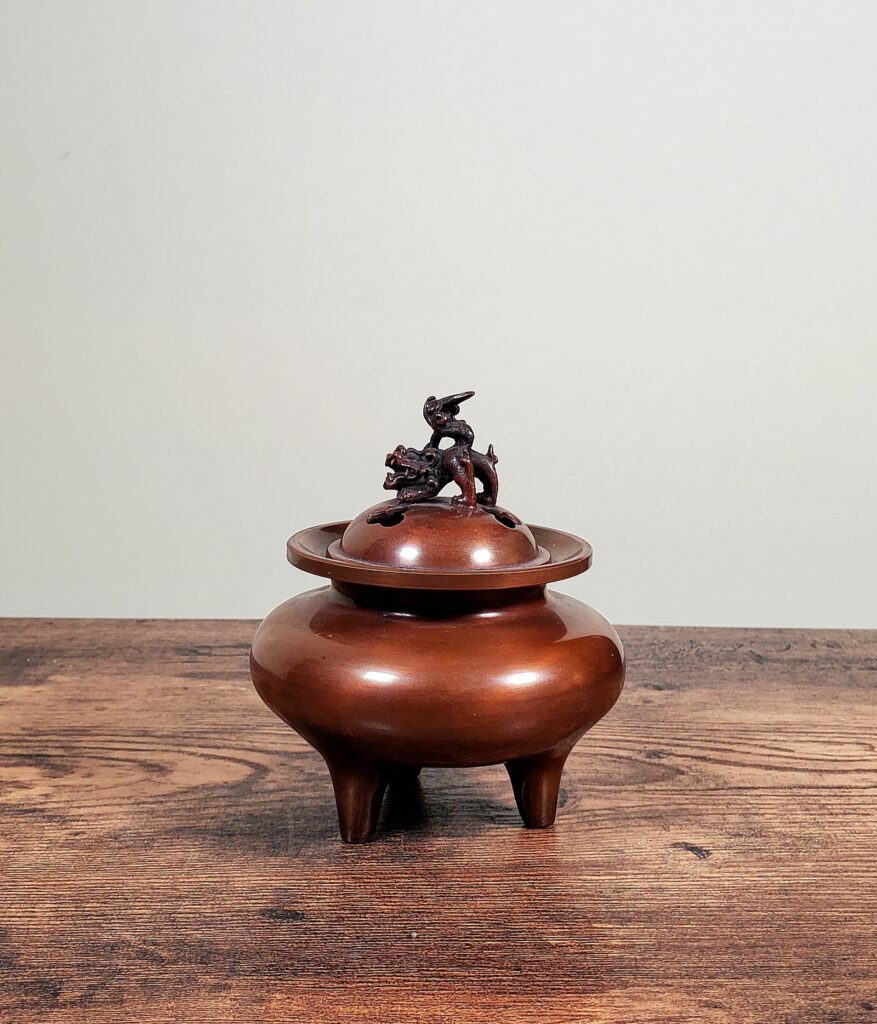
This bronze incense holder from Japan’s Showa period is in new condition. Three short legs support a smooth, rounded body with no handles; a broad, flat rim surrounds a domed lid topped by a small, detailed sculpted figure. Its shape raises a useful question: how can you tell whether a Japanese bronze favours handling or display?
Japanese bronze objects occupy a spectrum between utility and display. Kettles, water containers and vases may be lifted, tilted, carried and set down again. Their shape has to accommodate those movements and the weight of their contents. Presentation vessels and sculptural objects placed on a stand may be viewed mainly from a distance, where outline and surface detail become more prominent. A single vessel can serve both purposes.
Begin with the rim, the base and any projecting parts such as handles. These show where a hand might grip, how a vessel rests and which parts would need support during movement. Weight and surface treatment add further clues. Together, they help you judge how readily a form accommodates handling and how it presents itself when stationary.
These clues have limits. A decorative vessel still needs a stable base, and a vessel made for use can carry elaborate ornament. Shape provides evidence of practical possibilities; establishing how an individual bronze was used requires more than its appearance.
A thick or turned-over rim can resist knocks and offer a rounded edge against the fingers. A thin, crisp rim gives the opening a sharply defined outline, but may offer little comfortable purchase. Look at the edge and the space beneath it together: a projecting rim is only useful for lifting if the fingers can reach and support it securely.
The base answers a different question. A wide, flat base gives a vessel a broad area of contact with a table. A raised foot or a set of legs lifts the body clear of the surface, making the shadow beneath it part of the silhouette. The spacing of the supports matters as much as their appearance. A broad body does not by itself tell you how securely the piece stands.
Legs also illustrate how utility and display overlap. They support the body while changing its outline. Short, substantial legs and slim, widely spaced legs can produce very different impressions, but appearance alone cannot establish their strength. Follow each support from the table to the body and consider how the weight above it is carried.
Handles offer another direct clue. A handle intended to take a hand needs room for fingers and attachments capable of bearing the load. A slender or tightly curved handle with little room for a grip contributes mainly to the silhouette. Where there are no handles, attention shifts to the rim and the underside: which areas could be supported without putting pressure on a projecting detail?
Keep that distinction between support and ornament in mind around a lid. A sculpted figure at the top may draw attention without providing a secure lifting point. A projection’s visual prominence is no assurance that it can carry weight. This is a reason to ask how a piece should be handled before touching it.
Weight is a clue that photographs cannot supply. Bronze is dense, but size alone does not establish an object’s weight or balance. What matters during lifting is both the total load and where it sits in relation to the grip. If gallery staff permit and guide handling, notice whether the piece feels balanced between its supports or requires extra care to keep upright.
A low concentration of weight generally helps stability; weight concentrated higher up makes balance more sensitive to tilting. These are practical considerations for a vessel moved regularly. They also matter for display, where a piece must stand securely on its chosen surface. Heft alone does not place a bronze at either end of the spectrum.
Surface treatment changes what is comfortable to touch and what is legible from a distance. In Japanese bronze generally, smooth areas can sit beside textured ones. An even surface offers fewer interruptions to a grip, while raised detail can make some areas awkward to hold. The useful question is where those areas occur in relation to likely points of contact.
Contrast also affects viewing. A smooth, rounded body beside a detailed ornament gives the viewer a broad shape to follow and a smaller feature to examine closely. That arrangement can be effective on display while leaving other areas accessible for handling. Read the finish alongside the rim, supports and handles: each clue becomes more useful when considered with the others.
On the next Japanese bronze you examine, which feature gives you the clearest clue to handling: the rim, the base or a handle? Visit Gallery Mitsuido in Takayama, in the Hida region of Gifu Prefecture, to view selected works from the collection.
Contact us at giulio.dirienzo@gallerymitsuido.com or visit us at 3 Chome-1 Kamiokamotomachi, Takayama, Gifu 506-0055, Japan.