
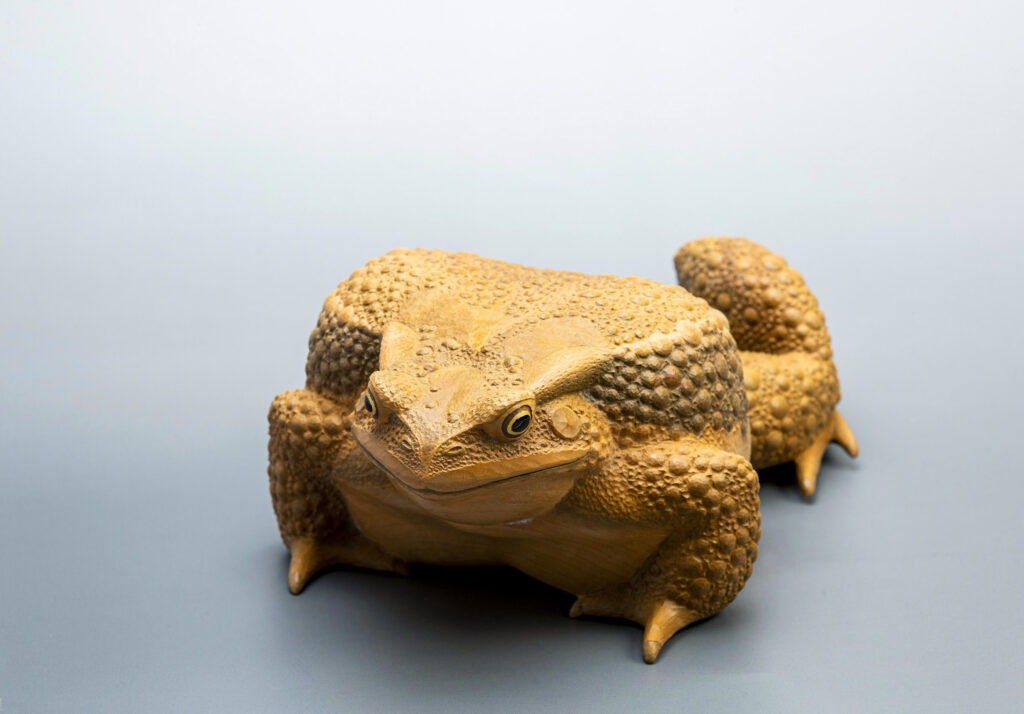
Hikigaeru is a signed Japanese sculpture carved in wood during the Showa period (1926–89), accompanied by a certificate and in new condition. It measures 10 high by 24 wide. Its shape and finish raise a useful question: does a work like this anchor sustained attention as a fixed focal point, or does it sit comfortably as an object of casual display? The answer is not always obvious, but learning where to look changes how we read carved figures across Japanese art.
Japanese wood carving includes figures found in very different settings. In a devotional context, a carving may occupy a fixed point where attention returns repeatedly over time: an altar, a shrine interior, or a household devotional space. In a decorative context, a carving may be scaled and finished for a shelf, an alcove, or a display case, where it can be encountered more casually. The carving techniques may overlap considerably. The principal difference lies in how the finished object is typically approached by a viewer.
A devotional setting usually establishes a stable relationship between figure and viewer. The carving remains in place, and the viewer returns to it from a familiar direction and distance. Frontal presentation therefore carries particular importance. Details along the primary viewing axis may receive greater emphasis because that is where attention repeatedly settles.
A display setting permits a different encounter. A figure placed on a shelf or table may be seen from several positions as people move around it. If it is sufficiently compact, it may also be lifted and turned. Its sides, back, and underside can consequently become part of the viewing experience rather than remaining secondary to a fixed frontal view.
These are broad patterns, not fixed categories. A devotional carving can be carefully finished on every side, while a display piece can still have a dominant front. Present surroundings are not conclusive evidence either: objects move, settings change, and a carving shown in a gallery may once have been encountered differently. The distinction is most useful as a viewing question, not as a label applied too quickly.
Three features offer a practical starting point: the base, the scale, and the distribution of finish. Each can be observed without claiming certainty about the maker’s intention or the object’s earlier setting.
Begin with the base. A figure functioning as a fixed focal point may have a base that establishes a clear front and keeps the carving stationary in one orientation. A figure suited to movable display may instead rest securely in several positions, allowing it to be turned and set down without losing its visual balance. The important question is not simply whether a base exists, but how strongly it directs the viewer toward one position.
Next, consider scale in relation to encounter. A carving placed in a dedicated devotional space may be sized for viewing from a set distance. A smaller display figure may instead relate more closely to the hand, a tabletop, or the depth of a shelf. Size alone proves nothing, but it affects whether the viewer stands before the carving, moves around it, or handles it directly.
Finally, compare the finish across the whole surface. When a carving is approached primarily from the front, the front may receive more detailed attention than the back or underside. When every side is likely to face the viewer, the finish may remain more consistent throughout. Turn this into a sequence of observations: compare front and back, examine where details continue or stop, and note whether the underside appears finished for viewing.
No single feature settles the question. A heavy base does not automatically establish a devotional setting, just as compact scale does not automatically establish decorative display. Base, scale, and finish become useful when read together. If all three direct attention toward a stable frontal view, they support one kind of encounter. If they encourage movement around the carving, they support another.
The value of this distinction is not merely classificatory. It changes the pace and direction of viewing. A fixed focal point asks for repeated attention from a stable position. Over time, small differences in posture, outline, and carving can become more prominent because the relationship between viewer and figure remains consistent.
A display carving encourages a more mobile kind of attention. The viewer may circle it, compare its profiles, or study how one carved passage connects with another. That movement is not less serious than stillness; it simply produces a different relationship with the object. Confusing the two contexts can mean overlooking the frontal concentration of a devotional carving or failing to examine the full surface of a piece that can be seen in the round.
When you next encounter a carved wood figure, look first at its base before turning to its face or surface detail. Does the base establish one sustained viewpoint, or does it encourage you to move? Then test that first impression against the scale and the consistency of finish. What kind of attention does the carving appear prepared to receive?
For details or private viewing, contact Gallery Mitsuido at giulio.dirienzo@gallerymitsuido.com or visit us at 3 Chome-1 Kamiokamotomachi, Takayama, Gifu 506-0055, Japan.