
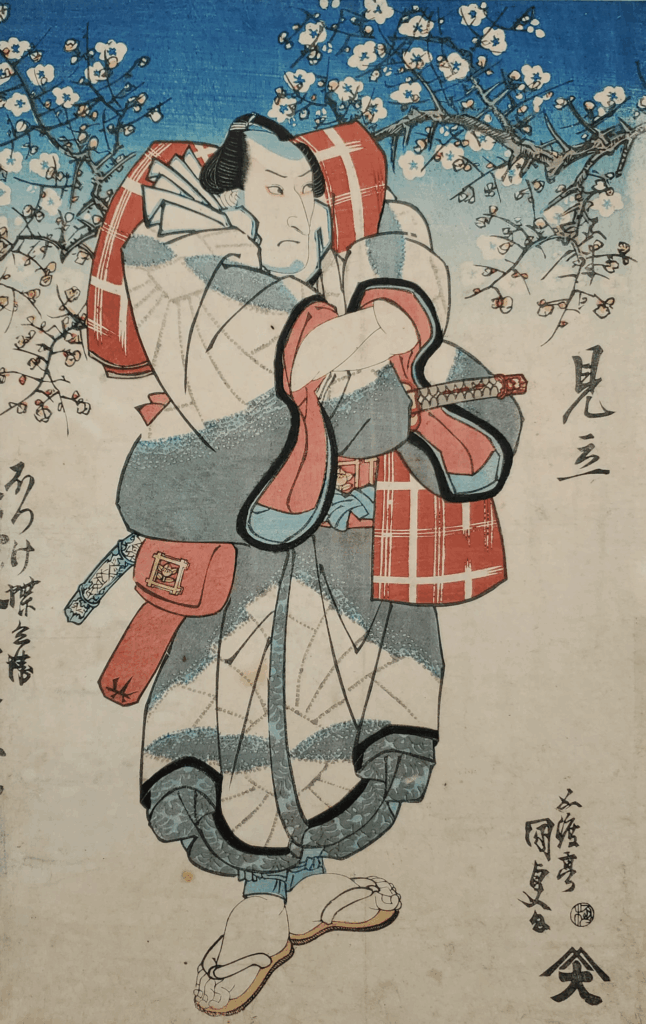
Kabukie is a woodblock print by Utagawa Kunisada, made with ink on washi. Between a designer’s brush drawing and a finished ukiyo-e print lies the work of cutting that design into wood. The apparent ease of a printed line depends on the precision of this translation.
In ukiyo-e production, a designer supplied a drawing, a carver translated its lines into wood, and a printer took impressions from the finished blocks. These tasks depended on one another. The drawing established the shapes and contours; carving gave those marks a raised surface that could carry ink to paper.
The drawing used to guide the carving was pasted face-down onto the wood. The carver cut along its lines and removed the surrounding wood, leaving the design standing in relief. The paper drawing was destroyed during this process. Preserving its character required close attention to both sides of each stroke: the space cleared around a line determined its printed width, its taper, and the shape of its end.
For a print with several colors, additional carved surfaces supplied the separate areas of color. Each had to align with the outlines and with the other color areas. Carvers cut register marks into the blocks to guide the printer’s placement of the paper during successive impressions. The accuracy of those marks mattered alongside the accuracy of the image itself. A precisely cut contour could only meet its neighboring color correctly if the paper was positioned consistently.
A brush stroke can broaden under pressure and narrow as the brush lifts. To reproduce that change, a carver has to preserve a ridge of wood whose width changes along its length. A tapering line therefore requires several controlled cuts around a narrow raised shape. Too much wood removed from either side changes the stroke that will appear on paper.
Fine hairlines, thin white gaps between printed areas, and sharp interior corners in a repeating pattern make these demands especially clear. A narrow curve must remain continuous. Closely spaced lines need enough wood cleared between them to keep their impressions distinct. At a tight corner, the cuts must meet cleanly while preserving the adjacent edge. Each detail depends on what is removed and what remains.
The grain of the wood adds another constraint. Narrow ridges can be damaged during cutting, and the carver must work without splitting or lifting the wood that will carry the ink. This makes a group of fine parallel lines demanding: every ridge and every intervening gap has to be maintained. In the finished print, that work becomes a set of apparently effortless marks. We see the sweep of a curve or the separation of individual hairs, while the cuts needed to produce them remain out of sight.
Edges offer a useful starting point when looking at ukiyo-e. Follow a fine line through a curve and observe where it widens, narrows, or comes to an end. Those changes had to exist in the raised wood before they could be printed. An even line and a tapering line demand different shapes on the block; both depend on control of the edges.
Where a print includes a checked or striped textile pattern, compare neighboring lines. Look at their spacing, their intersections, and the small open areas between them. In passages of hair or other closely spaced parallel marks, follow several lines through the same bend. The carved gaps are as important to their separation as the ridges that receive ink.
Color boundaries need a little more care to interpret. Where two colors meet, the result depends on both the cut edges of the blocks and the alignment of the paper during printing. Ink application and printing pressure also affect how clearly a fine line appears. A finished sheet brings these contributions together, so a sharp edge alone cannot isolate the carver’s skill from the printer’s. Carving establishes the shapes available to print; printing determines how those shapes transfer to the paper.
Next time you look closely at a woodblock print, follow one continuous fine line from end to end. Where does it narrow, and how clearly does the space beside it remain open?
Contact us at giulio.dirienzo@gallerymitsuido.com or visit us at 3 Chome-1 Kamiokamotomachi, Takayama, Gifu 506-0055, Japan.