
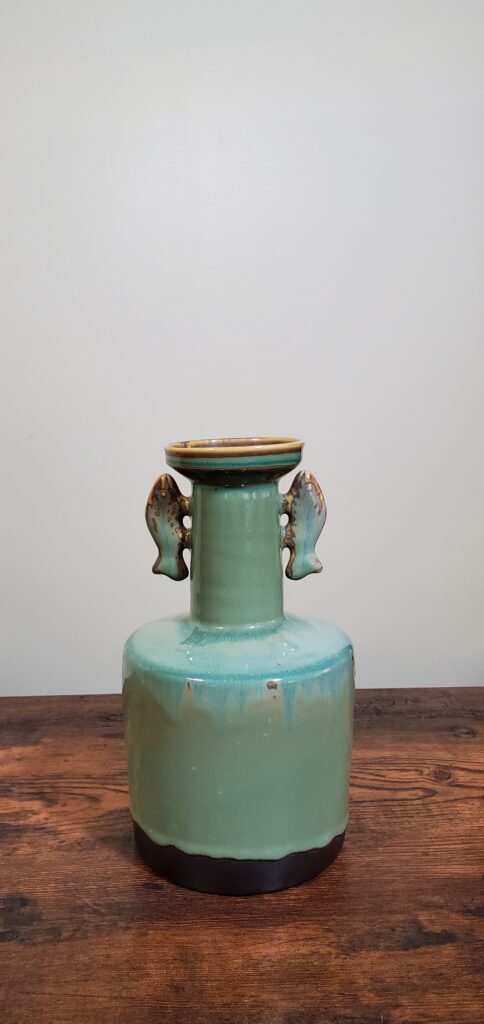
This ceramic flower pot from Japan, signed by Kato Gozan and from the Showa period (1926–89), is finished in celadon glaze. The narrow band of unglazed clay around its base, together with the marks there, draws attention to a useful place to begin examining ceramics: the foot, where the clay and traces of its shaping remain exposed.
The foot is the part of a vessel that supports it. On many glazed ceramics, the surface that touches the kiln shelf is kept free of glaze to prevent it from sticking during firing. This practical requirement leaves a small area where the clay can be examined directly. Beside a glazed body, an exposed foot offers a different kind of information: the texture of the fired clay and the surface left by the tools that shaped it.
Glaze changes how we see the clay beneath it. Its color, thickness, and pooling contribute to the appearance of a vessel, while an unglazed area makes the clay itself easier to inspect. At the foot, look for a smooth cut, a rough patch, or a line continuing around the base. These details can help explain how the lower part of the vessel was finished before it entered the kiln.
The foot also has a shape worth examining. Its width and the way its edge meets the body affect the vessel’s profile. Looking at that junction brings the construction into focus, adding information that painted decoration alone cannot supply.
Many thrown ceramic forms are shaped in two stages. First, the soft clay is formed on the wheel. Later, once it has stiffened enough to hold its shape, a blade or loop tool removes excess clay from the base and refines its profile. This second stage is called trimming. It can define the foot and leave traces of the tool’s passage in the exposed clay.
On a trimmed base, concentric lines can follow the movement of the turning vessel against the tool. Look at whether they continue evenly around the surface, become deeper in places, or end where another cut begins. A broad, smooth area and a series of narrow grooves show different results of contact between tool and clay. Following those differences is a practical way to examine how the surface was worked.
Interpret these traces cautiously. The spacing of lines alone cannot establish the speed of the wheel, and the depth of a remaining groove does not measure all the clay removed during trimming. The firmness of the clay, the tool, and the pressure applied can all affect the result. Nor does an irregular mark establish that the work was hurried: describing what survives is more reliable than assigning an intention to it.
Begin with a simple observation, such as “the cuts are shallow and continuous,” then consider what it supports. That approach keeps the lesson close to the evidence. It also makes comparisons useful: two feet may have similar outlines yet differ clearly in the traces left on their surfaces.
On a glazed Japanese ceramic vessel, begin by finding where the glaze stops. Follow that boundary around the base as far as it is safely visible. Notice whether the line is even or irregular, how much clay is exposed, and whether the exposed surface is smooth or marked by tools. Keep the glaze boundary and the trimmed edge distinct as you look: each offers information about a different part of finishing the vessel.
A clean glaze boundary may show care in preparing the base for firing, but the line alone does not establish exactly how it was cleaned. Likewise, a rougher area needs to be considered alongside the rest of the foot. Compare neighboring surfaces before drawing a conclusion from a single mark. The useful habit is to look for relationships: where a cut ends, where the glaze begins, and how the foot joins the body above.
The foot deserves the same attention as glaze and decoration. It can be deliberately shaped and carefully finished, even when much of it is hidden during display. Its value to the viewer lies in the construction details it makes available. Those details help you ask more precise questions about the making of the vessel.
At your next gallery visit, ask to see the base of a glazed ceramic vessel, or examine one safely in your own collection. What becomes clearer when you follow the unglazed band: the edge of the foot, the tool marks, or the glaze boundary?
For details or private viewing, contact Gallery Mitsuido at giulio.dirienzo@gallerymitsuido.com or visit us at 3 Chome-1 Kamiokamotomachi, Takayama, Gifu 506-0055, Japan.