
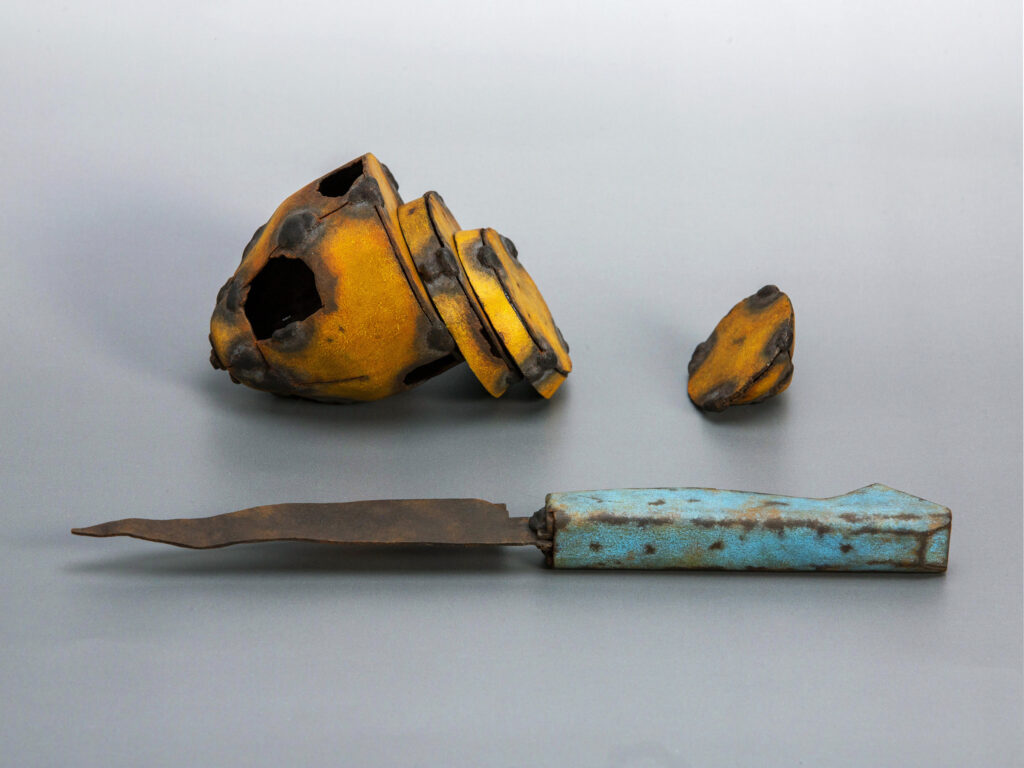
Gallery Mitsuido, in Takayama in the Hida region of Gifu Prefecture, presents a signed wood sculpture by Maehara Fuyuki, carved in Japan in the Showa period (1926-89). Wood sculpture poses a useful first question: is the wood exposed, covered with a finish, or visible only in selected areas? The answer affects how we read the carving in light and shadow.
Bare wood exposes the carved surface directly. Planes, ridges and knife facets catch light, while shadow describes the depth between them. Grain runs through the surface as well. Straight grain can cross a fold or a limb, while figured grain adds a pattern that may make the carved contours harder to follow. The wood’s structure also affects how cleanly an edge can be cut and how much texture remains around it.
On an unfinished surface, light reveals both the shape of the carving and the texture of the fibres. Sheen varies with the wood and how it has been worked: a rubbed area may reflect more light than a rougher one. Where tool marks remain visible, you can follow the direction of individual cuts and see where they overlap. Looking across the surface at a low angle helps separate those small marks from the larger planes that establish the figure’s shape.
Bare wood also changes with exposure and handling. Its colour can alter in light, repeated contact can polish high points, and changes in humidity can open fine checks along the grain. These changes affect the same surface on which the carving is visible. A smooth patch or a darkened area therefore needs careful reading; its appearance alone does not establish how the surface was first treated.
Many Japanese wood sculptures have a finish. The wood may be coated with urushi lacquer, covered with gold leaf or gold powder, or painted in mineral pigments over a white ground. Each treatment changes what remains visible of the carving. Depending on their thickness, the layers can soften sharp edges or obscure small tool marks. Colour can also separate one garment from another, mark a border, or make a detail legible from across a room.
Light behaves differently on these surfaces. Gold reflects light and can make a form stand out in a dim space. Glossy lacquer produces strong highlights on convex parts, with darker areas between the reflections. Matte paint gives fewer bright reflections, allowing colour boundaries and the shadows cast by the carving to remain clear. The effect depends on the finish’s texture as well as its colour: a smooth coating and a textured one scatter light differently.
Coverage matters too. A coating may extend over the whole figure, or colour may be applied only to selected areas while the rest is left exposed. That mixed treatment lets you compare wood and finish side by side on a single object. Follow a carved contour across the boundary and watch how its visibility changes with the surface.
Finishes also age differently. Lacquer can craze or lift in patches, gold can wear away at points of contact, and pigments can fade or flake. Where a coating is lost, the wood underneath may become visible. Exposed wood on a finished figure therefore needs to be distinguished from areas deliberately left uncovered. That distinction may require documentation or closer examination.
Start at the edges and recesses. A groove or the underside of a fold may reveal changes in coating thickness, exposed fibres, or tool marks. Then move a step sideways, or tilt your head, so that you see the surface under a different angle of light. Watch where highlights appear and disappear. Sheen offers clues, but it cannot identify a finish by itself.
Check the whole figure before deciding, because a sculpture can be finished in some areas and left bare in others. Bases, undersides and less visible faces may reveal wood covered on the main surfaces. Compare those areas where they are accessible without handling the sculpture. A difference in texture or colour is a useful observation to bring to a closer discussion of its surface.
Photographs can make these distinctions harder to see. Frontal lighting can suppress the shadows that reveal grain and shallow cuts, while a glossy surface can flare into a white patch. In a gallery room, moving your viewpoint lets you follow the reflections across a curve and see which details remain legible as the light changes.
Compare a figure with exposed wood and one with a covering finish. Where do you see the carved contours most clearly, and where does colour or reflection guide your attention?
Contact us at giulio.dirienzo@gallerymitsuido.com or visit us at 3 Chome-1 Kamiokamotomachi, Takayama, Gifu 506-0055, Japan.