
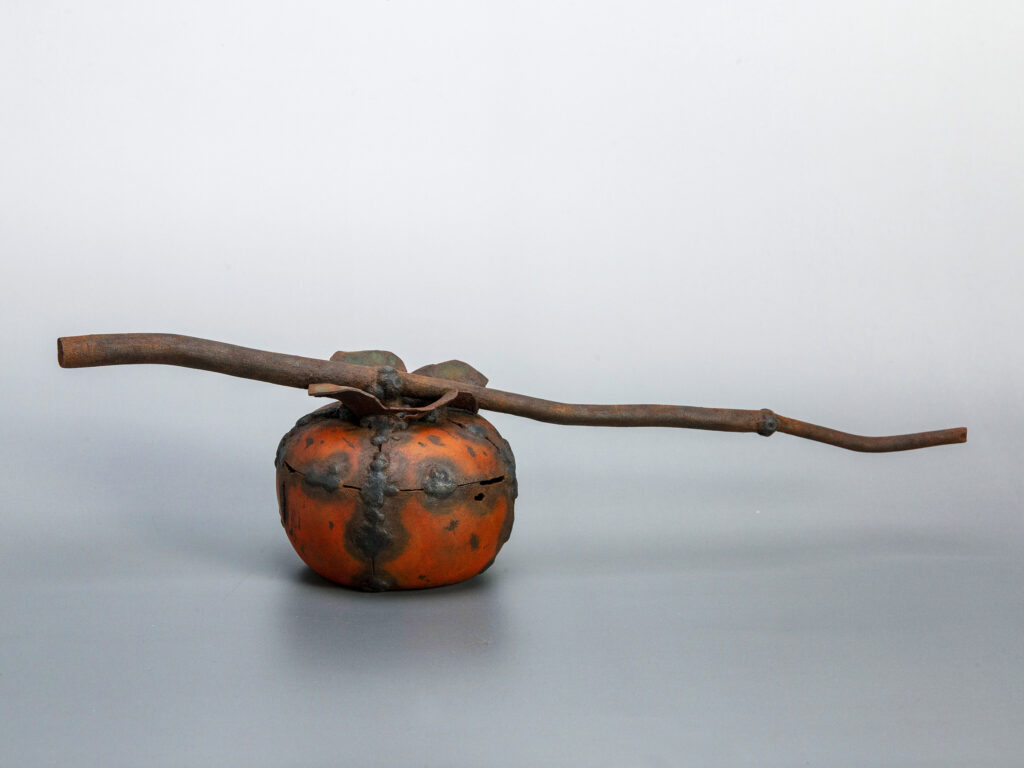
Gallery Mitsuido in Takayama, in the Hida region of Gifu Prefecture, presents a signed Showa-period wood sculpture by Maehara Fuyuki, carved in Japan. Its compact rounded mass and the long slender element laid across the top draw attention to weight and angle—two features that also shape how we read posture in carved figures.
In Japanese wood sculpture, posture gives a viewer an early sense of whether a figure is settled or about to move. Weight carries much of that message. A standing figure with its load on one leg can suggest ease or movement, while weight shared evenly can suggest formality and stillness. A seated figure on a wide, low base appears stable. A forward lean over a narrow base can suggest alertness. These readings depend on how the parts of the body work together.
Wood carving removes material from a block, so the broad stance needs to be established early. The carver works inward from the outer volume, and changing a stance late in the process may require wood that has already been cut away. The position of the torso over its support therefore affects the whole carving. Even a small shift changes the relationship between the upper body and the area beneath it.
When you look at a carved work, start at the base. Find the lowest and widest part of the mass, then follow the line upward. Check whether it rises straight, shifts to one side, or leans forward. Compare the position of the torso with its support: does it sit centrally above it, or extend beyond it? Comparing two sculptures this way helps make the difference between a settled posture and a poised one visible.
A slight head tilt can change the reading of a carved figure. A level head may suggest composure, a lowered head attention or inwardness, and a turned head attention directed beyond the figure. None of these is a fixed meaning. A lowered head above an upright torso has a different effect from a lowered head above a body that also bends forward. Read the angle of the head in relation to the shoulders and torso.
Hands add another point of comparison. An open hand, a closed hand, a hand at rest and a raised hand each suggest a different kind of moment. In a compact carved figure, hands held close to the body keep the outline contained; a hand extending away from the chest opens a space between hand and torso. That gap helps make the gesture visible even before you examine the fingers.
Follow the gesture through the arm. A hand close to the chest may belong to an arm with the elbow tucked in or projecting outward, and those positions produce different outlines. Looking at the hand alone misses part of the posture. Trace its connection through the wrist and elbow to the shoulder, then check how that arm relates to the body’s lean.
Begin with where the weight sits, then check the direction of the head and the position of the hands. Together, these observations give you specific evidence for a reading of the posture. They also help you distinguish what you can see from a story you might attach to it.
Surface treatment affects which cues are easiest to see. Bare wood exposes grain, natural colour and any visible carving marks. Grain has its own direction within the wood; carving reveals it differently as the surface turns. It need not follow a fold or a raised arm. To judge posture, trace the carved contour as well as the grain, keeping those two kinds of line distinct.
Lacquer or another coating changes the appearance of the wood and may obscure the grain. Outline and mass then become especially useful guides. Follow the slope of a shoulder, the projection of an elbow or the space beside an arm. The same checks work on bare wood: surface detail can attract attention, while the outer contour shows how the body is arranged.
For a sculpture without a head or hands, compare the rounded masses and slender elements in the same way. Look at where the weight rests, the direction each element extends and where they meet. These relationships provide a way to read balance and movement across different carved forms.
On the next carved sculpture you see, find where the weight rests before examining the face or hands. How much of its posture can you read from the base and outline alone?
Contact us at giulio.dirienzo@gallerymitsuido.com or visit us at 3 Chome-1 Kamiokamotomachi, Takayama, Gifu 506-0055, Japan.